
Product Description
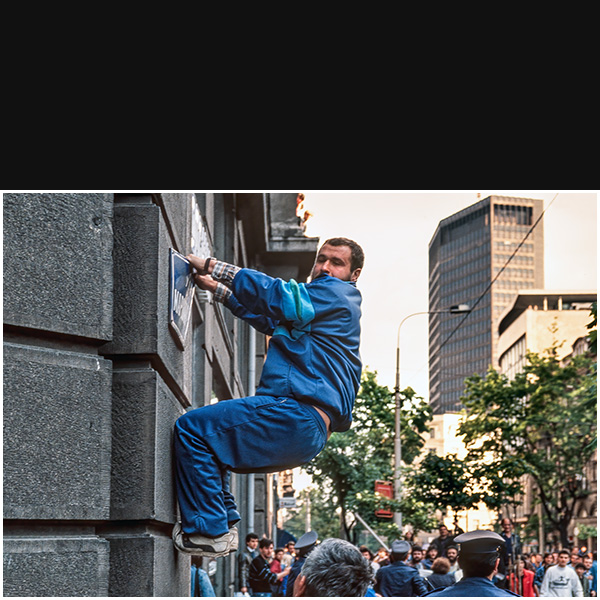
In photograph no. 30, taken—as far as I recall—on May 5, 1990, a demonstrator is tearing down the street sign bearing the name Marshal Tito Street. It was the first sign of its kind to be removed. Shortly after this event, all remaining signs were taken down, and the street has never borne that name again.
This man probably had nothing against the sign itself. He may not even have had anything personal against Tito. But for him, Tito represented a symbol of oppression. In the figure of the former president, he saw the embodiment of the injustices that had weighed on him for years.
Perhaps he had been harassed by a superior at work—superiors who, at the time, were often members of the Communist Party, led for life by Tito. Perhaps his grandfather’s house had been confiscated and reassigned to a party official. Perhaps he had been denied employment for not being “morally and politically suitable,” since Communist Party membership was for a long time explicitly required in many job advertisements.
I do not know his personal story. What I do know is that symbols are never one-dimensional. Very often, what represents evil to some represents good to others. Tito, who for this man was clearly a symbol of oppression, remained for many people a symbol of social progress. Under that system, countless citizens were able to receive education, medical care, summer holidays by the sea, and winter vacations in the mountains.
That is why it is so important not to be exclusive, and to view history from multiple perspectives—just as a good photographer should always do.