
Construction Rhythm
€100–€600
EN
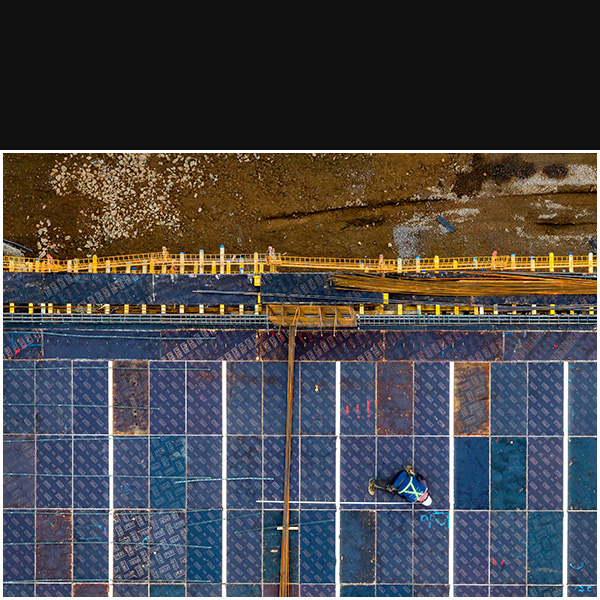
In the Roof Art series, I often encounter scenes that echo the great themes of world painting — geometry, rhythm, reduction, and the human measure. Viewed from above, construction sites turn into vast canvases where accidental traces of labor transform into compositions painters like Mondrian, Klee, or Malevich would immediately recognize.
The grid of formwork and white dividing lines naturally recalls Mondrian’s strict verticals and horizontals, except here the “colors” are industrial textures — metal dust, rain stains, plywood, and concrete. The repeating squares carry something of Paul Klee’s “architectures of drawing,” where each module has its own tone and story. Even Malevich’s radical simplicity is present in these rectangles that claim the image like basic units of a constructed world.
And in the middle of this enormous geometry lies a construction worker. His presence breaks the abstraction in the same way Rauschenberg used the human trace to bring life into the material surface. In his posture — leaning, resting, weighed down by gravity — there is a quiet tension reminiscent of Rothko’s fields: a human moment inside a monumental structure.
This interplay between industrial order and human effort captures the essence of Roof Art: from above, the everyday spaces surrounding us reveal themselves as unplanned works of art — compositions that were never intended to be seen, yet come alive only when observed from the air.
________________________________________________________________________________________________________________________
SR
U seriji Roof Art često otkrivam prizore koji me podsećaju na velike teme svetskog slikarstva — geometriju, ritam, redukciju, ljudsku meru. Iz visine, gradilišta postaju ogromna platna na kojima se slučajni tragovi rada pretvaraju u kompozicije koje bi mnogi slikari prepoznali kao svoje.
Na ovoj fotografiji, mreža oplata i belih linija gotovo prirodno priziva Mondrianove kompozicije, samo što su umesto čistih primarnih boja tu grube industrijske teksture, tragovi blata, metala i kiše. Raster koji se širi preko celog kadra ima nešto od Paul Kleeove „arhitekture crteža“, gde svaki kvadrat nosi svoju nijansu, svoju priču. Čak i Malevičev duh lebdi u ovoj svedenosti – pravougaonik kao osnovni element sveta.
A onda, usred te velike geometrije, pojavljuje se radnik. Njegova figura je kontrapunkt, živi element koji uvodi meru i smisao, kao što je kod Rauschenberga ljudski trag razbijao čistu apstrakciju materijala. U njegovoj poza, u težini tela položene na hladnu površinu, ima nešto i od Rothkovih „tihih napetosti“ – mali trenutak ljudskosti usred velike, teške konstrukcije.
Upravo ta kombinacija industrijskog reda i ljudskog napora jeste ono što Roof Art čini jedinstvenim: iz ptičje perspektive prostori koji svakodnevno nastaju oko nas otkrivaju se kao neplanirana umetnička dela, kompozicije koje niko nije zamišljao, ali koje postaju vidljive tek kada ih sagledaš iz visine.