
Silence Above the Market
€100–€600
EN
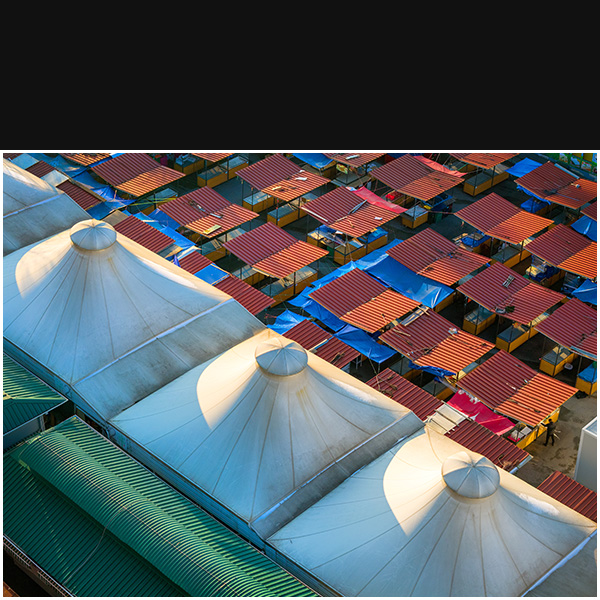
That afternoon, in the early hours of fading daylight, I photographed this view of Đeram Market. It was that moment of the day when the market slowly begins to shut down, yet is not entirely quiet; a time when the rhythm softens, when you hear only an occasional voice or the metallic rustle of tarps being folded by the vendors. That is why the scene appears almost empty — many had already left, and one vendor, in the lower right corner, was packing up and preparing to end his day.
Seen from above, Đeram no longer resembles a market. The red metal roofs create a grid that looks like the layout of an abstract city, while the blue tarps add rhythm and contrast, like bold brushstrokes across a large canvas. In the foreground, the white domed roofs of the central hall catch the afternoon light and turn it into soft shadows, almost like studio lighting calming the entire composition. This interplay of geometry, color, and light belongs entirely to the visual language of my Roof Art project.
Yet what makes this photograph special is not just the structure. It is the presence of people — even when they are barely visible. An empty market still speaks of them: of habits, work, routine, of the city’s daily rhythm that repeats itself with the same precision as the pattern of rooftops in the image. The whole scene carries a quiet, concluding note, like the final chord of a day that has already been lived.
Đeram is one of Belgrade’s oldest market sites, dating back to the time when a Turkish road passed through here, and at its crossroads stood a đeram — a traditional lever-operated well. Travelers stopped here to draw water, and over time a small settlement formed around it. In the 19th century, Đeram was a well-known station at the entrance to Belgrade, and later, when the present-day King Alexander Boulevard became a main city artery, the area grew into a lively marketplace. Today’s layout of stalls and halls rests on this long tradition: order, chaos, tarps, improvisation — all inherited through decades.
This is one of the photographs I am preparing for my upcoming monograph “A View of Belgrade,” planned for release at the end of the year. In it, I want to show Belgrade as we rarely see it — from above, as a vast organism with its own patterns, rhythms, and small rituals of everyday life. Đeram fits into that story perfectly: a place that is both chaotic and orderly, lively and empty, familiar and unrecognizable.
In that dual nature of Belgrade — between document and abstraction — I find its true beauty. That is why this photograph, although simple, becomes part of a much larger narrative: the story of a city that changes from minute to minute, yet from a bird’s-eye view reveals its hidden, unmistakable order.
____________________________________________________________________________
SR
Tog dana, u rano popodne, dok se sunce spuštalo pod blagim uglom, snimio sam ovaj pogled na pijacu Đeram. To je onaj deo dana kada pijaca počinje da se gasi, ali još uvek nije sasvim tiha; vreme kada se ritam usporava, kad se čuje tek poneki glas i metalni šuštaj cerada koje prodavci skidaju sa svojih tezgi. Upravo zato prizor deluje skoro prazno — mnogi su već otišli, a jedan od prodavaca se pakuje i sprema da zaključa dan.
Gledano odozgo, Đeram više ne liči na pijacu. Crveni limovi formiraju mrežu koja izgleda kao rešetka nekog apstraktnog grada, dok plave cerade daju ritam i kontrast, kao snažni potezi četkice preko velikog platna. U prvom planu nalaze se beli, kupolasti krovovi hale — njihove glatke površine hvataju svetlo i pretvaraju ga u meke senke, gotovo kao studijska rasveta koja smiruje kompoziciju. Taj spoj geometrije, boje i svetlosti pravi prizor koji pripada čistom vizuelnom jeziku mog projekta Roof Art.
Ono što ovu fotografiju čini posebnom nije samo struktura. To je prisustvo ljudi — čak i onda kada ih gotovo nema. I prazna pijaca govori o njima: o navikama, radu, svakodnevici, o ritmu grada koji se ponavlja iz dana u dan, sa istom preciznošću kao raspored krovova na fotografiji. Čitava scena ima neku tihu, završnu notu, kao poslednji akord dana koji je već obavljen.
Đeram je jedno od najstarijih beogradskih pijačnih mesta, još iz vremena kada je ovuda prolazio turski drum, a na njegovoj raskrsnici stajao pravi đeram — bunar s polugom za izvlačenje vode. Putnici su ovde zastajali da natoče vodu, pa se oko bunara vremenom formirala mala varošica. U 19. veku Đeram je bio poznata stanica na ulazu u Beograd, a kasnije, kada je Bulevar kralja Aleksandra postao glavna osovina grada, ovo mesto se pretvorilo u živu pijacu. Današnji raspored tezgi i hala nastao je na temeljima te duge tradicije: red, haos, cerade, improvizacija — sve to je nasledstvo koje se zadržalo kroz decenije.
Ovo je jedna od fotografija koje pripremam za monografiju „Pogled na Beograd“, knjigu koja treba da izađe iz štampe krajem godine. U njoj Beograd želim da prikažem onakav kakav najčešće ne vidimo — gledan odozgo, kao veliki organizam sa sopstvenim uzorcima, ritmovima i malim ritualima svakodnevice. Đeram se u tu priču uklapa savršeno: kao mesto koje je istovremeno haotično i uredno, živo i prazno, poznato i neprepoznatljivo.
U tom dvostrukom karakteru Beograda — između dokumenta i apstrakcije — nalazim njegovu pravu lepotu. Zato je i ova fotografija, iako jednostavna, deo mnogo veće priče: priče o gradu koji se menja iz minuta u minut, ali iz ptičje perspektive pokazuje svoj skriveni, neponovljivi red.