
Man and Space
€100–€600
EN
During my studies of architecture, I regularly followed the architectural magazine “Čovjek i prostor.” Perhaps that very connection — between man and space — remained somewhere as a quiet reference, unexpectedly reappearing today in this image.
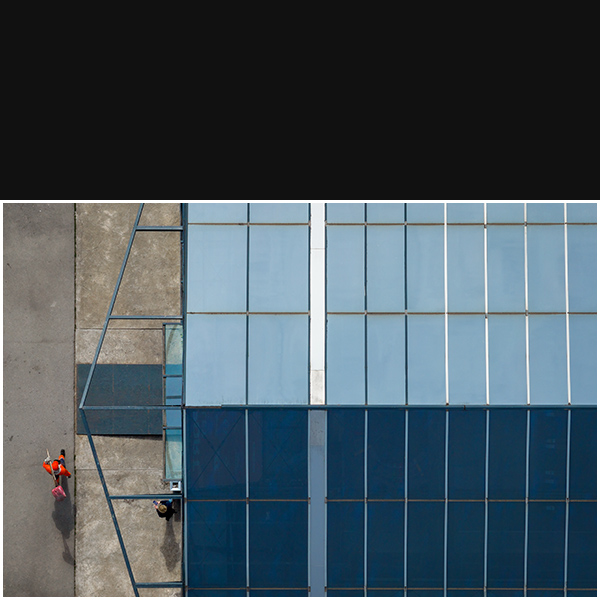
At first glance, the photograph appears as a precisely organized surface — a sequence of parallel lines, evenly distributed fields, and clearly defined tonal divisions. Everything seems designed to be stable, controlled, and enduring.
Only at the edge of the frame does something emerge that disrupts this logic.
Two figures, small in relation to the structure, occupy a space that does not belong to this system, yet touches it. Their position is not aligned with the rhythm of the lines. It does not follow it. It does not belong to it.
Here, architecture does not speak of a space for living, but of order — an attempt to organize, define, and keep space under control. The roof lines, regular and repetitive, function as a visual system that leaves little room for deviation.
And yet, precisely at its edge, life appears.
Without the intention to change it, without the need to understand it.
In that encounter — between the rigidity of construction and the freedom of movement — the photograph ceases to be a depiction of an object and becomes an image of relationships: between man and space, order and chance, what is designed and what happens beyond the plan.
SR
U vreme kada sam studirao arhitekturu, redovno sam pratio arhitektonski časopis „Čovjek i prostor“. Možda je upravo taj spoj — čoveka i prostora — ostao negde kao tiha referenca koja se danas, neočekivano, ponovo pojavljuje u slici.
Na prvi pogled, fotografija deluje kao precizno organizovana površina — niz paralelnih linija, ravnomerno raspoređenih polja i jasno podeljenih tonova. Sve izgleda kao da je projektovano da bude stabilno, kontrolisano i trajno.
Tek na ivici kadra pojavljuje se nešto što remeti tu logiku.
Dve figure, male u odnosu na strukturu, u prostoru koji nije deo tog sistema, ali ga dodiruje. Njihov položaj nije usklađen sa ritmom linija. Ne prati ga. Ne pripada mu.
Arhitektura ovde ne govori o prostoru za život, već o redu — o pokušaju da se prostor organizuje, definiše i zadrži pod kontrolom. Linije krova, pravilne i ponavljajuće, deluju kao vizuelni sistem koji ne ostavlja mnogo mesta za odstupanje.
Ipak, upravo na njegovoj ivici, život se pojavljuje.
Bez namere da ga menja, bez potrebe da ga razume.
U tom susretu, između strogoće konstrukcije i slobode kretanja, fotografija prestaje da bude prikaz objekta i postaje slika odnosa: između čoveka i prostora, reda i slučajnosti, onoga što je projektovano i onoga što se dešava mimo plana.