
The Rhythm of Shadow and Sun
€100–€600
EN
As a child, I often fell asleep watching the shifting images cast on the ceiling by car headlights passing through the curtains that swayed gently in the evening breeze. I felt as if every car painted its own, fleeting picture. I watched those reflections the way someone might watch their own private abstract film.
Many years later, during my architecture studies, I learned that Le Corbusier had noticed something remarkably similar: the way the shadows of horizontal or vertical wooden slats, in the late afternoon sun, create a dynamic geometry that changes from minute to minute. These slats, whose practical role was to reduce excessive sunlight, became known as brise-soleil. The term comes from the French briser — to break, to interrupt — and soleil — sun. “Light is the most important material of architecture,” he often said, and brise-soleil soon became one of his architectural signatures.
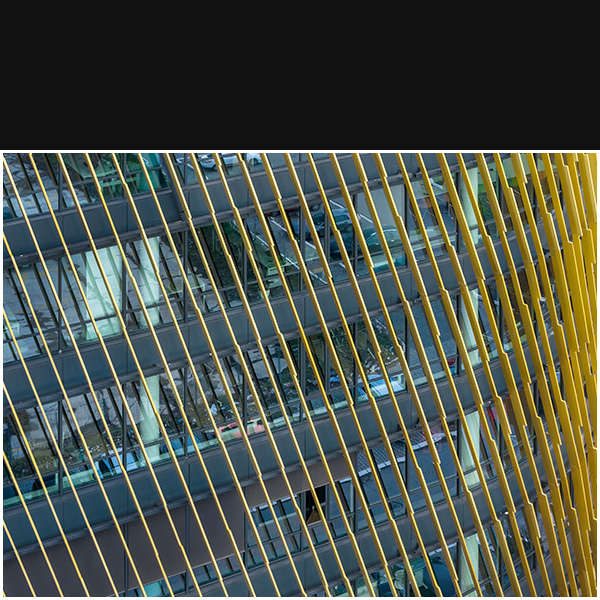
As I look at this façade from above, wrapped in a grid of dense golden slats, I feel a quiet yet compelling dialogue unfolding before my lens — a dialogue between contemporary technology and the history of architectural ideas. The gilded verticals catch and filter the sunlight until the façade begins to resemble a painting: a network of lines and colors that shifts and pulses with the movement of the day.
This dual reality — between exterior and interior, light and shadow, function and aesthetics — is what draws me so strongly to my Roof Art project and to the broader Belgrade from Above series. When I observe façades like this, I have the impression that the city itself is creating its own modernist compositions.
__________________________________________________________________________
SR
Sećam se da sam se, dok sam bio dete, uspavljivao posmatrajući slike koje su na plafonu crtala svetla automobila dok su njihovi farovi prolazili kroz zavese što su lelujale na povetarcu. Imao sam utisak da svaki automobil pravi drugačiji apstraktni film.
Mnogo godina kasnije, na studijama arhitekture, saznao sam da je Le Corbusier uočio isti taj fenomen: kako senke horizontalnih ili vertikalnih lamela, pod večernjim suncem, stvaraju živu, promenljivu geometriju koja se menja iz minuta u minut. Te lamele, čija je praktična uloga bila da spreče prekomeran ulaz svetlosti, nazvane su “brise-soleil”. Reč je sastavljena od “briser” — lomiti, prekinuti, i “soleil” — sunce. „Svetlost je najvažniji materijal arhitekture“, govorio je poznati arhitekta, i od tada je brise-soleil postao jedan od njegovih zaštitnih znakova.
Dok iz vazduha gledam ovu fasadu obavijenu gustim, zlatnim lamelama, osećam kako se pred objektivom odvija poseban dijalog: dijalog između savremene tehnologije i istorije arhitekture. Zlatičaste vertikale hvataju i filtriraju sunčeve zrake tako da fasada počinje da liči na sliku — mrežu linija i boja koje pulsiraju u skladu s kretanjem dana.
Ova dvostruka stvarnost — između spoljašnjosti i unutrašnjosti, svetlosti i senke, funkcije i estetike — jeste ono što me najviše privlači u projektu “Roof Art” i u celom ciklusu “Beograd iz vazduha”. Kada gledam ovakve fasade, imam utisak da grad sam stvara svoje modernističke kompozicije.