
Young Summer
€100–€450
EN
When I was a young photographer, I came across photographs by Franco Fontana that depicted Tuscany in a way that completely captivated me at the time — fields filled with dense, lush green grass, broken into countless shades and tonal variations, where light does not simply rest on the surface, but seems to enter the color itself and bring it to life. Those images stayed with me for a long time, not as specific scenes, but as a feeling that a landscape can be both real and almost painterly at the same time.
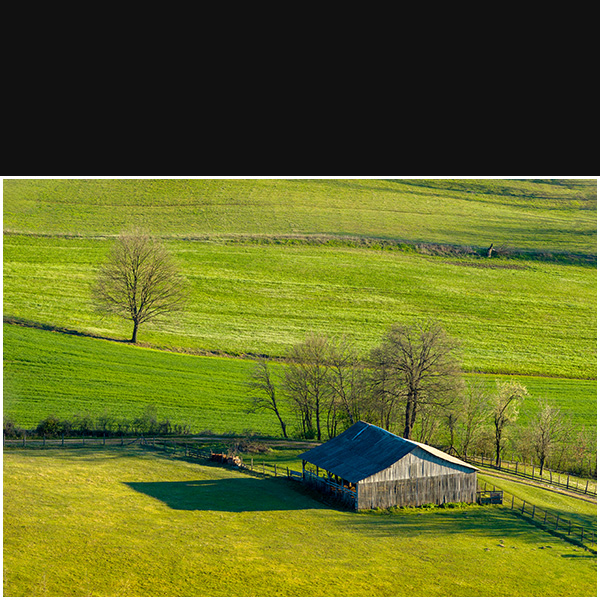
Today, many years later, a scene from the surroundings of Belanovica brought me back to that very sensation — to that same fullness of green, to the gentle rhythm of rolling terrain, and to the way light moves across the surface, transforming it from moment to moment. Without much hesitation, I could call this photograph by the same name it would carry if it had been taken in Italy — Primavera.
But this is not Tuscany.
And that is where a difference begins — one that is not only geographical, but also linguistic, almost conceptual.
In this region, in an older layer of language, the year was not divided into four clearly defined seasons, but rather into two fundamental states — winter and summer, cold and warm, stillness and growth — so what we now call spring actually belonged to the beginning of that warmer world. It was not a separate, distinct period, but an entry into summer, its first form, not yet fully developed, but already irreversible.
That is why there existed a term which today sounds almost forgotten: young summer.
There is no abrupt transition in that expression, no clear boundary — it speaks of a process, of a gradual opening of space, of a time when green is no longer a promise but a presence, when light no longer falls at a sharp angle, but lingers, extends, and fills the landscape. Seen from above, as in this photograph, that process becomes visible in layers — in the gentle lines of the terrain, in the differences between lighter and darker surfaces, and in the shadows that do not interrupt the landscape, but complete it.
Elsewhere, all of this might be called Primavera.
Here, however, it has its own name — quieter, older, and closer to the land.
Here, it is — young summer.
A name that does not describe only a time of year, but also a way of seeing it.
SR
Kada sam bio mlad fotograf, naišao sam na fotografije Franka Fontane koje su prikazivale Toskanu na način koji me je tada potpuno oduševio — polja ispunjena gustom, sočnom zelenom travom, razlomljena u bezbroj nijansi i valera, gde se svetlost ne zaustavlja na površini, već kao da ulazi u samu boju i čini je živom. Te slike su u meni ostale dugo, ne kao konkretni prizori, već kao osećaj da pejzaž može biti istovremeno i stvaran i gotovo slikarski.
Danas, mnogo godina kasnije, jedna scena iz okoline Belanovice podsetila me je upravo na to — na tu istu punoću zelene, na ritam blagih talasa u terenu i na način na koji svetlost prelazi preko površine, menjajući je iz trenutka u trenutak. I mogao bih, bez mnogo razmišljanja, da ovu fotografiju nazovem istim imenom kojim bi se zvala da je nastala u Italiji — Primavera.
Ali ovo nije Toskana.
I upravo tu počinje razlika koja nije samo geografska, već i jezička, gotovo misaona.
Nekada se na ovim prostorima, u starijem sloju jezika, godina nije delila na četiri jasno određena godišnja doba, već na dva osnovna stanja — zimu i leto, hladno i toplo, mirovanje i rast — pa je ono što danas nazivamo prolećem zapravo pripadalo početku tog toplog sveta. To nije bio poseban, izdvojen period, već ulazak u leto, njegov prvi oblik, još uvek ne sasvim razvijen, ali već nepovratan.
Zato je za taj trenutak postojao izraz koji danas zvuči gotovo zaboravljeno: mlado leto.
U toj reči nema naglog prelaza, nema jasne granice — ona govori o procesu, o postepenom otvaranju prostora, o vremenu kada zelena više nije obećanje nego prisustvo, kada svetlost ne dolazi više pod oštrim uglom, već se zadržava, produžava i ispunjava prostor. Gledano odozgo, kao na ovoj fotografiji, taj proces postaje vidljiv u slojevima — u blagim linijama terena, u razlici između svetlijih i tamnijih površina, u senkama koje ne prekidaju pejzaž, već ga dopunjuju.
Možda bi se negde drugde sve to nazvalo Primavera.
Ovde, međutim, to ima svoje ime — tiše, starije i bliže zemlji.
Ovde je to — mlado leto.
Ime koje ne opisuje samo vreme u godini, već i način na koji ga vidimo.